
2 posts tagged with "Data Skew"

View All Tags

The Complete Apache Spark and Iceberg Performance Tuning Checklist

· 35 min read
Cazpian Engineering
Platform Engineering Team

The Complete Apache Spark and Iceberg Performance Tuning Checklist

You have a Spark job running on Iceberg tables. It works, but it is slow, expensive, or both. You have read a dozen blog posts about individual optimizations — broadcast joins, AQE, partition pruning, compaction — but you do not have a single place that tells you what to check, in what order, and what the correct configuration values are. Every tuning session turns into a scavenger hunt across documentation, Stack Overflow, and tribal knowledge.

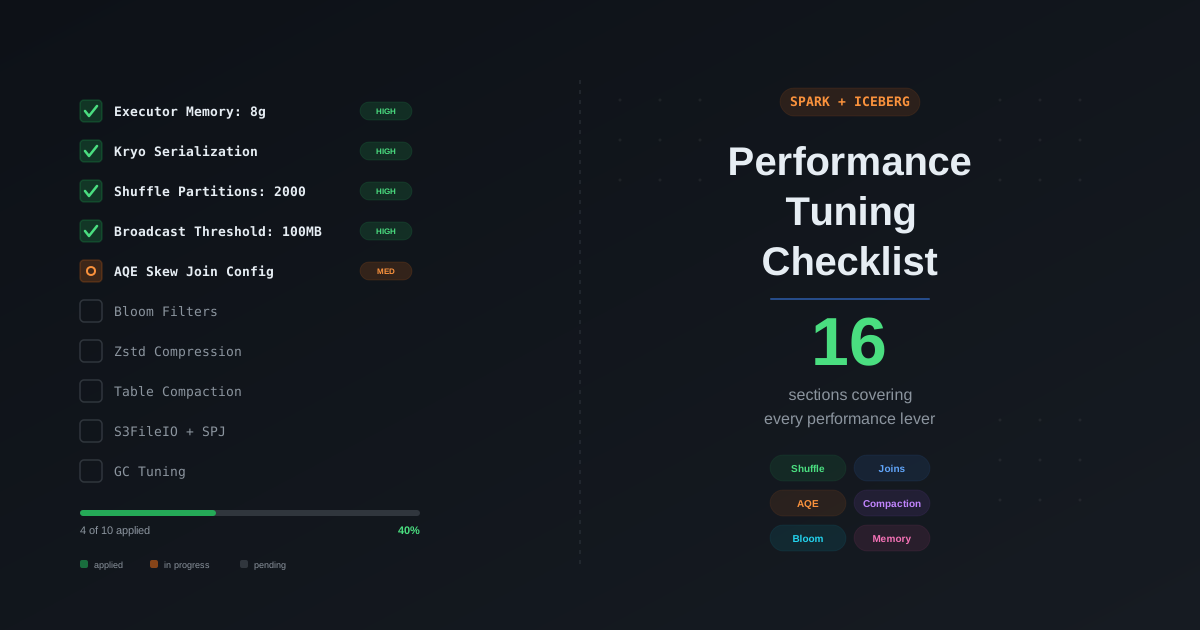
This post is the checklist you run through every time. We cover every performance lever in the Spark and Iceberg stack, organized from highest impact to lowest, with the exact configurations, recommended values, and links to our deep-dive posts for the full explanation. If you only have 30 minutes, work through the first five sections. If you have a day, work through all sixteen. Every item has been validated in production workloads on the Cazpian lakehouse platform.

Spark Data Skew: The Complete Guide to Identification, Debugging, and Optimization

· 35 min read
Cazpian Engineering
Platform Engineering Team

Spark Data Skew: The Complete Guide to Identification, Debugging, and Optimization

Your 200-node cluster finished 199 of 200 tasks in 30 seconds. The last task has been running for 45 minutes. Every executor except one is idle, burning compute cost while it waits for a single partition containing 80% of the data to finish processing. The stage progress bar is stuck at 99.5%. Your Spark job that should take 2 minutes is taking an hour.

This is data skew -- the single most common and most destructive performance problem in distributed data processing. It turns a perfectly parallelized cluster into an expensive single-threaded computation. It wastes money, wastes time, and breaks SLAs. And it is entirely fixable once you know how to identify it and which optimization to apply.

This post goes deep on every dimension of data skew. We start with what it is and why it kills performance, show exactly how to identify it in the Spark UI, catalog every type of skew you will encounter, cover the AQE automatic optimizations that handle skew at runtime, walk through every manual fix with code examples, address Iceberg-specific skew problems, provide a complete configuration reference, and close with the anti-patterns that cause skew in the first place.